Showing posts with label in the field. Show all posts

Friday, March 11, 2016

Family Math

I promised that I would give you a glimpse of what family math looks like around here.  I know folks are wondering "Is this method sustainable?  Will you really be able to cover all of the things you need to cover for a range of different ages and abilities of children in a whole-group setting?"  So here is the answer: "I don't know!"

I really haven't done this long enough to know if there are cases where this model will prove more challenging.  But I have definitely seen many beautiful aspects of this approach.  Let me share with you a few anecdotes and then a few observations.

Examples:

  • We did a review of the concept of place value using play money - hundreds, tens and ones - over the course of a few days.  The children practiced exchanging between hundreds and tens and between tens and ones.  We experimented with what happens when you add, subtract or divide a three digit number, and which order (hundreds, tens, ones vs. ones, tens, hundreds) makes the most sense for each process.  My ten, nine, eight and six year olds were all in participation.  The older three have definitely mastered the concepts of regrouping and their application to the three operations we examined.  The six year old showed a clear understanding of place value, but not as great a fluency with "regrouping" and didn't apply it to the operations.  That's OK.  She's learned some and become familiar with the concept.  She'll have plenty more exposure to it in future.
  • I realized that, though my six-year-old can tell time fairly well, she was having trouble taking into consideration the movement of the hour hand as the minute hand makes its way around the entire clock face.  I planned to take a moment during math time to talk about this with her, but since the older children were sitting nearby, the conversation turned into a discussion of percentages and proportions with the older children when one of them said,  "So, if the minute hand has gone 25% of the way around the clock, then the hour hand should have also moved 25% of the way between two numbers ..."  This reminded us why it is that we refer to times as "a quarter past" or "a quarter til" and we also talked about the reason (historically) that the minute hand is larger than the hour hand.  We also discussed that situations like this illustrate the usefulness of percentages, because they allow us to make comparisons between the parts of two different-sized things.
  • We are now studying Geometry.  Sometimes we read one of the Sir Cumference books.  All of the children (except the baby who still takes a morning nap) sit and listen as I read.  We have also done some hands-on activities.  The oldest four participate and the younger two (ages 4 and 3) go back and forth between being engaged and doing their own thing nearby.  For example, as we explored perimeter and area, we used Blokus pieces to make rectangles of different sizes and to calculate the perimeter and area in the pretend units of a Blokus (B) and a square Blokus (B2).


Thoughts:
  • In pretty much every other subject, my approach has been to teach the older kids and let the younger ones listen in and glean whatever they are able.  Why not math?  It can't hurt, right?
  • If math is a conversation, then each person can engage at the level to which he is able.  Older children can bring more complex ideas to the table and younger ones can pick up on the simpler aspects of what we're learning.  Math really isn't as compartmentalized as we tend to think - there is so much overlap and interconnectedness.  And making connections between previous learning and current learning is a huge piece of what education is all about.
  • Math as a conversation easily overflows to other times of the day (like lunchtime) because we've all been a part of the discussion, not just Mama and one kid.
  • When other children are getting a concept and one is not ... Do I stay on that topic and approach it from a different angle to see if I can make it clear?  Do I determine that that one child just isn't developmentally ready, and move on, figuring that she'll grasp it later on another pass when she is ready?  Do I find a chunk of time to work individually with her on that topic?  From where I sit right now, it seems like any of the above would be a viable option.  I know how to track what has been mastered and what hasn't.  So if not everyone is on top of a concept, it doesn't have to stop us from moving forward and doing the next thing as a group.
Have you ever explored math in a multi-age group?  What worked for you?  What did you like or dislike about that approach?  In reading over the descriptions above, what questions come to mind?  What is concerning about that approach?  What is attractive about it?  I'd love to hear your thoughts!

Thursday, March 10, 2016

Buy All the Things

This is the last part in a series based on this cost/benefit analysis.  Here you can find Part 1:Scoping out the SequencePart 2: Making the GradePart 3: UnschedulingPart 4: Why DIY?Part 5: Race to the Finish Part 6: Do Over and Part 7: Finger on the Pulse.  The last "plus" isn't truly a "benefit" but it's one of the most fun ones to write about, so here we go:

  • I don't have to pay for textbooks.  But this almost doesn't count, because there is no doubt that I'll find other ways to spend the money on our homeschooling ... some of them probably made necessary by this approach.

So here are some of the things I've spent money on instead of math textbooks:

And here are some of the things I can imagine myself going overboard and using up the entire tax return purchasing in the future:


by Mrs. Pinkerton
From Homeschool Ryan Gosling

Monday, March 7, 2016

Do Over

This is the sixth part in a series based on this cost/benefit analysis.  Here you can find Part 1:Scoping out the SequencePart 2: Making the GradePart 3: UnschedulingPart 4: Why DIY? and Part 5: Race to the Finish.  Next I want to talk about this "plus" for us in letting go of our math textbooks:


  • A LOT less time spent explaining work and correcting (and re-correcting) work.

I want to say up front that what I'm comparing here isn't really, purely, textbooks vs. no textbooks.  What I'm comparing is the way we used to do math vs. the way we do math now.

Before:

"Math" every day was sitting with one kid at a time and explaining to him what to do on his math assignment.  It went something like this:

"See, they're showing you that in order to divide by a fraction, you just flip it upside down and then  multiply.  Does that make sense?  Here, try this one.  Exactly! Good!  Got the idea?  OK, so you are going to do these five problems about that.  And then how about if you do one of these ... and one of these ... one from each of these sections ... and a word problem and, sure you can do all the Roman numerals.  OK, go get your sister and tell her it's her turn."

So, basically, it was like math, minus all of the best parts of math.  There was no exploration.  No wonder.  No awe.  No lightbulb moments.  No connecting the concepts.  No conversation.  Like a Dementor had kissed our homeschool math.


Maybe we can get into all that some day, I'd tell myself.  Some day when I didn't have to spend 15-20 minutes x 4 kids just telling them what they had to do on their worksheet for the day.  Someday when I wasn't exhausted by all of the exertion of the "management" of six other people while I tried to spend an hour meeting with each of the least destructive ones individually.

And what about quiet work time in the afternoon?  It went something like this,

"Good, all of your Roman numerals are correct.  Oooh, sorry, your long division problem is wrong, so you'll have to do that over.  Stop grumbling; math is supposed to be challenging.  And, oh, wait.  Yikes!  You weren't supposed to flip BOTH of the fractions upside down.  Only the second one.  Oh dear.  I guess I didn't really explain that very well.  OK, maybe I can go over this with you tonight and you can do all these over tomorrow along with tomorrow's math."

Good fun, right??  Can you tell why the kids and I all dreaded math?

Now, all of the exploration of new concepts happens together in a group.  There is still some "people management" - there always will be - but usually the oldest four are engaged (they are either hands-on or answering with their dry erase "slates") and the younger two are coloring, which is their version of "doing math".  And quiet work time?  Sure, they still get problems wrong.  And there are still corrections to be made.  But not as many because:
  1. They are only doing review work - not work on new concepts.
  2. There are only five problems.
  3. There is only one problem per topic, so no more discovering that they've done eight problems in a row wrong because they didn't understand one concept.
I've gotten some questions about what "family math" looks like these days.  I promise to write a post on that when I'm finished with this series (almost done!) but I have to say up front: we've been doing this less than two months!  I can tell you what it looks like so far, though, for what it's worth.

Saturday, March 5, 2016

Race to the Finish

This is the fifth part in a series based on this cost/benefit analysis.  Here you can find Part 1:Scoping out the SequencePart 2: Making the GradePart 3: Unscheduling and Part 4: Why DIY?.  Next I want to talk about this "plus" for us in letting go of our math textbooks:

  • I'm not bound up by a need to "finish" a purchased curriculum,  or "get  my money's worth"; no need to weed through and pick out which parts of a lesson to do.

Yes, I have hang-ups.  Yes, I have first-born perfectionist tendencies (though you wouldn't know it to look at my house!).  Yes, it somewhat bothers me to purchase something and then leave it incomplete (more on that in a moment).  But that's not really the pivotal factor in this benefit for us.

We all want to make sure we cover our bases in teaching our kids any subject, but especially one as central (in our world, at least) and developmentally sequential as math.  How does one make sure she covers all the stuff she's "supposed" to cover?  Well, the simplest way to achieve that is to let someone else (usually someone who has a lot more background in the subject) do the research and planning.  You purchase a textbook.  When you've covered all the things in that book, then you move on to the next one.

Sure, you can take a textbook and pull it apart and mix it all up and use it differently.  But unless you are committed to finishing everything in that book, you need some other system for keeping track of what has been covered and/or criteria for deciding what should be covered and what should be omitted or saved for later.

As I mentioned above, it does somewhat bother me that we've got these half-used textbooks on the shelf.  But I got myself into that situation on purpose.  I wanted to experiment ... but I wanted to experiment with a safety net.  I figured that if we tried this system for a couple of months and it didn't work, we'd just pick up our textbooks again.  I also figured that I wanted a few months to test the theory before convention came around (for us that's June) and I needed to decide whether or not to purchase new textbooks for next year.

At this point, I am so enjoying what we've been doing here that I don't see myself wanting to go back to the textbooks.  In fact, I've been letting the kids use up the pages doing "school" with each other in their free time.  I thought that perhaps they would come in handy in case I was in a pinch and I needed something quick to pull out and give the kids to do.  Here's why that hasn't been an inviting option (yet):


  • There are tons of problems on a page.  Deciding what to have the kids do takes some work in and of itself.
  • If I'm there and I don't have 5-A-Days prepared, I can just put some problems up on the whiteboard, everyone can do them on their dry erase "slates" and we're done.  (If I really want to, I can even open up the spreadsheet and track as we go.)
  • For days when I am going to be out (such as to appointments with the orthopaedist!) there have been so many things I've wanted the kids to have more time to do that it isn't a problem to leave them with other activities, like snuggle number!


So, in summary, the real benefit behind not having to "finish" a textbook stems from the fact that we've un-linked progress tracking from textbook scope and sequence.  We keep track of what we've learned, mastered and practiced elsewhere, so we are free to use or not use whatever we want from the textbook - and many other sources as well!

Monday, February 29, 2016

Scoping Out the Sequence

Back here I gave a rough outline of my cost/benefit analysis of going without textbooks (at least in math).  Since I've gotten some questions about the the reason behind them, I'd like to do a brief post expanding on each of the items I mentioned as "pros" for us.

  • I'm not constrained to a particular scope and sequence (order of topics) and can order them based on learning opportunities, whole-family instruction and the developmental abilities of each child.

I want to stress (again) that there isn't anything wrong with purchasing curriculum with a scope and sequence or following one.  As mothers, our resources are limited.  It is not a cop-out to choose materials that take some of the work off of our plates!  However, at this point in the life of our family, the scope and sequence in our textbooks felt more like a restraint than a help.

As I looked through the children's textbooks (grades 6, 5, 3 and 1), I realized that there was a great deal of overlap in topics - at varying degrees of complexity, but related to the same general ideas.  However, these topics were not presented in the same order in each grade.  My first impulse was to tear all of the pages out of each of the (consumable) books, rearrange them by topic and use binder clips to clip together all of the pages that fell under the same general concept.  The problem with that idea was that since I'd be teaching the topics out of order (according to each individual textbook) and since an Abeka math page is about 25-40% work on the current topic and 60-75% review, the children would potentially be assigned "review" problems for concepts they had not yet learned.

Sure, I could create a system for keeping track of what each kid had already learned and then assign or skip over review problems accordingly.  But if I am going to keep track of those details and have that close of a handle on who needs to review what, the limited options offered on each math page actually become more of a restraint than a boon.  More on this when we talk about ...

  • I get to create the lessons and activities myself.

Saturday, February 20, 2016

A Very Simple Schedule

At the beginning of the week, I felt a moment of crisis because I knew that I needed to spend more one-on-one time with my new reader and my struggling reader.  The schedule already felt packed and scary and the thought of adding one more thing was daunting (to put it mildly).  Monday evening, I attended Part 2 of the Focus and Align class at the Read Aloud Revival and the beginnings of some ideas began to percolate.  We had two hard, rough days, followed by two good, smooth encouraging days, followed by one more hard, low, rough day (as viewed from my internal perspective, only).  And here, in retrospect, is what I think has settled out to be our new schedule*:
  • Breakfast (sometimes while listening to a recorded book or story)
  • Morning Chores, Joseph (1) to nap
  • Read the Bible
  • Talk about Math
  • Talk about Language
  • Meet one-on-one with Luke (10) and Robyn (6) to practice reading skills
    Emma (9) and Ruth (8) take turns doing things with Henry (4) and Hazel (3)
  • Lunch
  • Quick Straightening, Hazel (3) and Joseph (1) to naps
  • Quiet Work Time (Math 5-A-Days, Latin and some silent reading)
    On Tuesdays this is replaced by "Latin Class" with another family
  • Play Outside
  • Final Clean-up
  • History (on-line course the kids do as a group) while Mama fixes dinner
That's it.  That is all we can do in a day.  And some days we don't accomplish all of that.  If you look closely, you'll probably notice things that aren't included.  I bet your list wouldn't be even a third of the things that are on my mind.  But I'm setting that aside for right now.  Let tomorrow worry about itself.  This is what we can do right now.


* We do school Monday-Thursday.  Fridays are for laundry, housework and maybe projects.

The Next Thing

One of the things that I have recently found to be a crushing burden of homeschool (for me, for now) is the feeling of needing to "finish" something in a given time.  I fear that if I don't finish it, my kids will be "behind".  I fear that if I don't finish it, I will have wasted the money I invested in it.  I fear that if I don't finish it, I'll miss out on that break I was hoping to take when it is all done.

For some (and even for me, in other phases of life) the structure is helpful.  It's nice to have someone else plan out what a year's worth of work includes, how much to review when and what should be included in a day of work or practice.  It feels very tidy to have five days worth of activity and begin again on Monday.  When we are able to get it done, it brings a sense of completion and closure.  But those days are getting much fewer and farther between.

Perhaps I'm less able to accomplish something that would be good to accomplish.  Perhaps the new pressures and constraints of life at this moment are revealing "shoulds" that never should have been "shoulds" and I am now releasing myself from them.  But whatever the case (and in some ways, it really doesn't matter) there is only this: what can we - at this stage, with this present grouping of children and this present, tired mama - accomplish in one day?  That is it.  What has God given us to do on this day?  Let's do it.  Let tomorrow worry about itself.

And what if we get to the end of the day and it wasn't all done?  Then not all of those things were things God meant for us to do today.  Yes, maybe there was time wasted.  Maybe we could have been more efficient.  But on this day, at this moment, whatever the causes, the task is still the same - trust to the Lord what wasn't accomplished and wake up tomorrow to start on the next thing.

As much as possible, I have moved away from organizing our subjects such that they must be done on a daily or weekly schedule in order to "work".  I've tried to avoid setting up things such that if we miss a day we are "behind" and have to try to cram two days worth of work into one (or three into two).  Instead it has worked much better for us if Mama has a general sense of the next thing(s) she'd like to teach or work on with the children.  When we come to school time, we do the next thing.  And if we don't get to it, it is tomorrow's next thing.

Didn't read a chapter of our read aloud book?  It will still be there tomorrow.  Talked about place value but they didn't fully "get" the concept?  Talk about it some more tomorrow; try another approach.  Time to start school but not all the morning chores aren't complete? They can wait until the next slot of time for getting a little work done.  (Or, do a little more housework and some school things can wait until later.)

The only way to make this system a reality has been, as much as possible, to unchain activities from each other so that each piece can move forward (or not!) independently.  Since our math discussion and written practice are no longer directly linked, we can do one without the other, if needed, on any given day.  Since the children's Five-A-Days are all things that we have already covered and they are just reviewing, we can take more time than I expected to work on our current concept without interfering with the Five-A-Day work I picked for them.  Or, conversely, if we didn't get a chance to complete the Five-A-Days, they can wait for the next day and our morning math conversations can keep happening.

This week, my oldest was only able to finish three out of the five problems on his Five-A-Day one afternoon.  Rather than requiring him to "catch up" on those two and do five new ones the next day, I simply took those two problems, added three more and they were his Five-A-Day for the next day.  If we've determined that five problems in a day is what we can manage, then why plan to do seven?  There will always be more good things to discuss and practice.  What do we gain by "doubling up"?  What are we racing against?  More and more, for us, the answer is: nothing!


Note: The two subjects that still "need" to fall into a weekly pattern are History and Latin.  And for now, I'm going to let them stay that way.  I'm not at all convinced that Latin is something all homeschoolers must do, but I have a degree in Latin and, quite frankly, it's something I love to teach.  Plus, our pastor's wife and her two youngest come over on Tuesday afternoons to do Latin with us, which is a big plus in the be-with-people category (perhaps even more for Mama than for the kids!).  We began three years ago with Song School Latin and are now working through the Latin for Children series.  We are on Primer B out of C, so after next year we'll reevaluate what to do next.

Though it is not absolutely essential, our history program works best done in five-lesson-a-week rotations because every five lessons covers one topic.  I absolutely love the Veritas Press History for many reasons.  Content-wise, it covers history, including Church History, map skills and lots of historical context.  Each era of history has its own song which helps the children to have a mental framework for the order and relationship of historical events, as well as some key dates.  Another plus is that it is on-line, very interactive, and the kids can do it on their own (mostly) while I watch and listen from the kitchen as I make dinner.

Friday, February 19, 2016

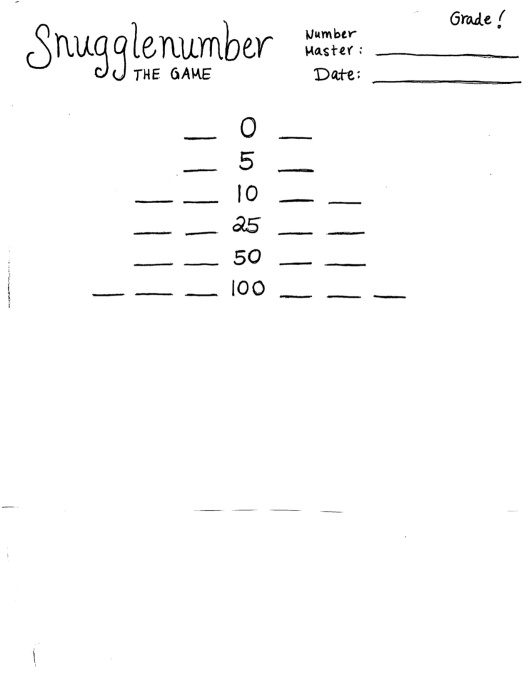
Snuggle Number


Snugglenumber pic

So.  This has been a challenging week.  At some point I need to write a follow-up post to the very somber-toned ones I put up on Monday.  But right now I feel more like keeping it light and sharing something fun!

A couple of days ago on Instagram a friend shared a picture of her kids playing a game called Snuggle Number.  I asked her for the scoop and she sent me to this blog post (I am in love with the blog title, too!).  I had been thinking about making and laminating some hundreds charts to use with the kids as another thing they could write on with their dry erase markers and this took up just enough room to fill up the blank space at the bottom, so, on it went.

All you need is a chart like this (which you could easily create by hand on scratch paper in moments) and a 10-sided die or a deck of playing cards, minus the face cards and jokers (count the Aces as 1 and the 10's as 0).  Roll the die or draw a card, then record that digit somewhere in the eleven slots on your game board (the original above is two-sided to allow for two games before the paper has to be tossed; my board below is simplified for little learners and since it is dry-erase is already reusable).  The goal is to get as close to the "target" number as you can in each row.  My board includes spaces for the kids to write the difference between their number and the target number and to add the total because I felt like they might need a little more structure to understand the gameplay.  More thorough discussion of the rules is on the blog above.


Want a copy?

Here is a copy of Snuggle Number only (half-page sized, so you could print two on a page)
Here is a copy of the whole thing I printed for my kiddos: addition chart, multiplication chart, hundreds chart and Snuggle Number (Note: For the number charts I used a special handwriting font which I don't think will show up via a Google Drive share, so the formatting will be a little different.)

Friday, February 12, 2016

DIY Math on the Level

As much as I have raved about Math on the Level (and I DO love what I know of it and WOULD recommend it if anyone was considering it) I haven't actually purchased a copy of the material.  I have looked over a friend's copy of the material, read everything there is to read on the website and taken a few webinars with the author.  But at the moment, part of our "experiment" is testing out a kind of a home-grown version of a Math-on-the-Level-like system.

From what I know (and chime in if you know better than I do) here are the essential things Math on the Level offers:

  1. What to Teach - Math on the Level clearly outlines and describes what your children need to understand and what skills they need to master in order to be ready for Algebra.
  2. How to Teach - Math on the Level books are full of very detailed explanations of each topic and lots and lots of good ideas about how to teach math and specific suggestions about how to help your children encounter individual topics, especially in "living math" ways.
  3. How to Assess - The primary means of assessment is in face-to-face interaction with your student as you teach the lesson.  The material also includes many, many practice problems (and answers) for each topic so that you will have plenty of options for making up their Five-A-Days.  Also, the record keeping system (either by spreadsheet or paper/pencil) enables you to know what has been mastered and what needs review.
At this point, my working theory is that I have resources available to accomplish all three of these these things.
  1. What to Teach - Using a combination of the table of contents to the math textbooks my kids have used in the past (because I still have the answer keys), the Mathematics Common Core lists and the Math on the Level list, I've put together my own list of topics.  (It's basically the same as the Math on the Level list, with a few additions/modifications.)
  2. How to Teach - This is the part I love best and that I most appreciate having the freedom to do on my own.  However (ironically?) it's also the part where I feel the most insecurity.  If I purchase my own copy of Math on the Level, it will be mostly for this reason - because I want to make sure that I teach each concept completely and thoroughly.  We've also been making use of Math Antics and  Kahn Academy to help us out with the how-to-explain-this aspect.
  3. How to Assess - I love the Math on the Level method.  I've basically adopted that method by use of a free spreadsheet I found on-line (which saved some time, but could be easily made from scratch by someone who had some basic knowledge of spreadsheets).  I already believe strongly in assessment by conversation (even in math) and am liking the new method of only five practice problems a day just to ensure that skills stay sharp.  Also, since I have teacher answer keys from all of the children's past Abeka textbooks, I have an enormous supply of practice problems (and answers).  And, of course, the Internet (including  Math Antics and  Kahn Academy) contains abundant resources for practice.  Of course, the benefit of the Math on the Level practice problems is that they are arranged and indexed by topic making it much easier to grab just what you need.
So, will this DIY method work?  Or will I end up purchasing a (used?) copy of Math on the Level?  Or, will I throw my hands in the air and just order everyone an Abeka textbooks for next year?  Stay tuned to find out.  Or, watch paint dry.  Either way, should keep you on the edge of your seat and provide great family entertainment. ;-)

Friday, February 5, 2016

Details on Demand - Part 2

In my first Details on Demand post I talked about how a friend suggested Math on the Level and what an amazing discovery that was.  However, the post was getting long, time was getting short and, to be honest, my spreadsheet wasn't finished yet.  Now that I've got a completed spreadsheet under my belt (that's an odd mental image, isn't it?) and a little more time, here's the rest of the summary overview of our new system.

In the last post, I shared an image of the main/first page of our spreadsheet:


This worksheet lists all the concepts to be tacked before Algebra.  The X's on the right simply indicate mastery - concepts that are ready for review.  However, I also have separate worksheets for each child.


Each child's individual worksheet enables me to track not only what concepts they need to review, but how often they need to review them, when they have recently reviewed that topic and how they fared with it.  Here's a sample of Luke's worksheet.


"Max intended" lists how frequently I'd like Luke to practice this concept.  Because I'm just getting my feet wet (and because Luke has a ton to review ... this is only about half of his list) I've put most everything at 21 days (once every three weeks).  However, he had a little difficulty with #76 Converting Between Customary Units, so I upgraded that to a once-a-week (7 days) review.  The blue column shows how many days have passed since the last practice and the column to the right of that displays *** if the topic is up for review.

As I assign new problems, I put in the date to the right.  The gray column tracks the most recent time that topic was covered.  I took this screen snip after assigning Luke 5-A-Days for 2/3/16 but before updating the spreadsheet to show how well he did so that you could see the ones assigned for a particular day.  Even though he only does five problems per day, one problem can review multiple concepts.  For example, I was able to ask one question that addressed both #10 and #11 and another question that addressed both #7 and #129 (Comparing Fractions).

Problems given on previous days and already checked have been color coded.  Green means he got it correct.  Yellow indicates a problem he missed, but was able to correct without any help.  Red (not shown here) indicates he had trouble and needed help.  More than one red and I'll reassess whether this is really a concept that belongs in the "mastered, ready for review" group.

For comparison, here's Robyn's personal worksheet.


While the screen snip from Luke's page showed only a portion of his review concepts, this is everything for Robyn.  A much smaller list.  And so a much more frequent rotation.

Another day I'll go into more detail about why this system is so great for us.  And I know I've just dropped a blizzard of new blog posts on folks, so feel free to take a few days to sift through it all.  It may be that long before I get back to adding anything new because my next project is to get the Language spreadsheet up and running.  Enjoy your weekend!

P.S. There is a Youtube Video giving more detail about how to use this spreadsheet narrated by the person who created it (a Math on the Level homeschool mom).  It won't be of much use/interest to you, unless you are thinking of personally adopting this kind of system.  Otherwise the summary above is sufficient.

Day 8: No Five-A-Days

We did morning school time as usual.  But I chose to forego the Five-A-Days because we were so behind in Latin.  We used the afternoon time to help the older children catch up on that work.  It reminded me of why I am so excited about the idea of not having textbooks, because it eliminates the concept of being "behind" and needing to cram many days worth of work into one or two days.  It reminds me of the need to make resources work for me ... and not the other way around!

Day 6: Sub Plans

My mother and father came over to stay with the children while we took Hazel to the hospital for her procedure.  I was able to leave them with some Five-A-Day's to give the children and  a few other activities, mostly just so that the children would have some structure and routine and not suffer from running-wild-because-I-have-no-structure-or-routine syndrome.  For the most part it went smoothly.  One kid had more trouble that I would have expected with math and another more trouble than I would have expected with language.  But in my mind, it was still a success because ...

1. I was able to leave them work to practice which was productive and yet was review so (theoretically) didn't require individual instruction to prepare them to complete it.

2. Because each of their questions was aimed at a specific objective, the work that didn't go as well as planned wasn't a waste of time.  It was data gathering towards a clearer understanding of what has been mastered and has clearly move into "review" territory ... and what hasn't!

That evening, Matt was exhausted and went to bed earlier (because, as we found out in the nigh, he was coming down with the flu!) so I used the evening to go over the kids' Five-A-Days with them.  I also stayed up until midnight finishing the foundation-laying work on the spreadsheet - not because I felt I had to, but because I'm a dork and that's something I find fun.

I know I still haven't finished explaining how I've gone about selecting those Five-A-Day questions.  Hopefully I'll be able to cover that today.

Monday, February 1, 2016

Day 5: When Plans Change

(Note: We homeschool Monday through Thursday.  So today was Day 5 of the experiment.)

This morning we were on a good track.  Breakfast was done, chores were happening and we were moments from sitting down for "morning time".  And then Hazel fell off my bed and broke both of the bones in her right forearm.  Daddy came home and watched everyone while Mama and Luke took Hazel from one doctor to another.  Poor little lady.

But, though there was no direct instruction today, the children were still able to complete the 5-A-Day work I had already prepared.  And this evening, I went over it with them and they made some corrections.  Tomorrow I should be able to leave them with another set to complete.  This experiment is far from over, but this method sure has proven to flex as well as a circus contortionist!

Thursday, January 28, 2016

Day 4: Flexibility

Today I had an afternoon visitor.  The kids were able to flop on the floor in the school room and do their 5-A-Days by themselves while I chatted with my visitor in the library.  This is amazing because in the past when I have tried to do this, people have needed my help knowing what to do on their school work.  And other people have taken advantage of my absence to do mostly nothing.  But not today.  All work was done.  And for the most part it was done well.

Some day I'll get around to actually talking about what I'm trying and why!

Day 3: "Slates"

The only new thing yesterday were the "slates" I made for the kids so they could be more hands-on participants in the lessons I was doing with them in the morning.  I printed some handwriting sheets and grids on cardstock paper and laminated them.  I ordered some washable dry-erase crayons and washable dry-erase markers (both Crayola products) and the whole system has been a huge success.  Unforeseen bonus: when I give the kids a break from school, most of them stay at the school table and draw so they are all available and ready when we get started again!

When I was a school teacher, my students used dry-erase markers and boards.  I wonder now if all the parents secretly hated me for it.  It is impossible to get those stains out of clothing!  Even the dust from erasing stains permanently!  I had read reviews of these washable options and they seemed less than glowing.  However, we thought both products were amazing.  The only thing I can figure is that Crayola has changed the product recently, or perhaps people were looking for something substantial enough to write on a big board for students to see.  They are probably not dark/thick enough for that.

I know I still haven't gotten into much of a discussion of all those things I promised to tackle.  In my mind there is a "chronology" of thought progression that makes sense.  Getting it all in written form - that's another thing!  Soon, I hope!

Tuesday, January 26, 2016

Day 2: Conversations with my Self-Doubt

Doubting Self: Wait a minute.  Think about all those visuals in the Kindergarten and First grade math books.  What are you going to do - draw clocks and coins by hand?

Confident Self:  Well, maybe I will!  I could totally do that!  Or I'm sure I could find images on-line and cut and paste.

Doubting Self: Right.  How dumb. You could just spend $15 and buy the textbook instead of making it all from scratch.

Confident Self: Or, maybe we won't even need much of that.  Since we're moving towards "living math" maybe we'll just use real clocks and real money.  Isn't that even better than pictures of clocks and money??

Doubting Self:  Sure, sure.  I'm sure you'll have tons of time to just sit around with your Kindergartener playing with clocks and coins.  No sweat.  You only have FOUR older students who have way more complicated math to learn.  Can we say "burnout"??

Confident Self: But ... but ... OK, I admit it!  I don't know how this is going to work out!  And maybe I will decide to go back to how we were doing it before - and that would be OK!!  But this is just an experiment.  And we haven't even completed a week of it.  So, could you ... could you just be quiet and leave me alone!?!

Doubting Self: ...

Confident Self: ...

Monday, January 25, 2016

Day 1: Whew. We made it.

This morning after I made the inaugural post on the blog (which went up around 6:45) I worked on labeling the binders, starting the very roughest framework of a spreadsheet and writing up 5-A-Day Language and 5-A-Day Math sheets for four kids ... plus one "bonus" school sheet for Henry so he could be a big kid.  The morning was similar to our usual schedule but I added in some math discussion with the older kids.

This afternoon they got their first shot at the 5-A-Days.  We began at 1 p.m.  All their work was done in under an hour and they did some silent reading while I checked their work.  Within about an hour and fourty-five minutes everything was wrapped up and they were on their way outside.  It took me until about 4 p.m. (just over an hour) to make new Five-A-Days for their binders, but that's a bit of an inaccurate measure of time, because it also included suiting, un-suiting and re-suiting people for snow and nursing a baby.  All in all, I think we came out about equal in terms of time invested, but way ahead in other respects.  Tonight I'll need to put in a big "push" to further flesh out the skeleton framework I began in my spreadsheets this morning.

I know I still haven't explained the spreadsheet, the face-to-face conversations or even what a 5-A-Day binder is.  But that will have to wait.  While you are waiting, here are some pics from school work.  Whew.  If only dinner could make itself tonight. ;-)